
Vietnam is becoming an interesting sourcing option for pipe fittings. The country has a large manufacturing base in metal processing, machining, casting, forging, and finishing.
However, the Vietnam Pipe Fittings market has an important gap. Vietnam has many metal suppliers, but fewer factories specialize in high-precision fittings.
This difference matters when sourcing fittings for North American customers.
A supplier may have strong machining or casting experience. However, that does not always mean it can produce fittings with tight tolerances, stable threads, pressure resistance, and consistent quality.
This article provides a practical look at Vietnam Pipe Fittings manufacturing, including materials, production methods, testing, finishing, standards, and supplier capabilities.
Common Types of Pipe Fittings
Pipe fittings connect, control, or change the direction of pipes. Different industries use different fitting designs.
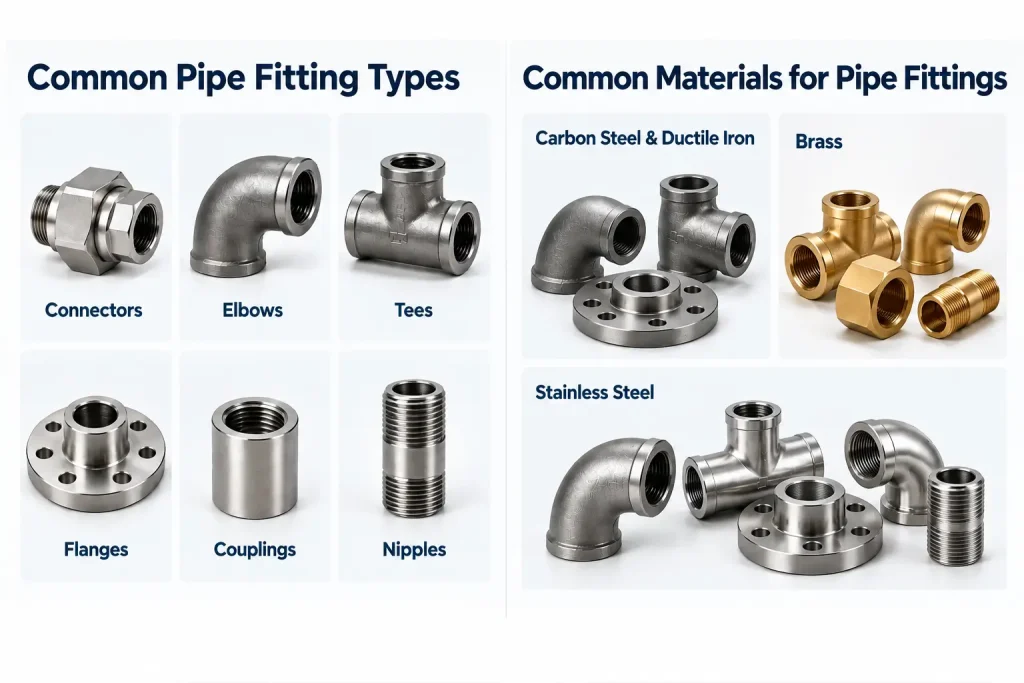
Common types include:
- Connectors
- Couplings
- Elbows
- Tees
- Reducers
- Adapters
- Flanges
- Bushings
- Unions
- Caps and plugs
- Valves and related components
Among these products, simple fittings are generally easier to source.
On the other hand, high-precision fittings can require more advanced machining, forging, testing, and quality control.
Therefore, buyers should evaluate the supplier based on the actual fitting design rather than only looking at the supplier’s general metalworking capability.
Materials Used for Vietnam Pipe Fittings
Vietnamese manufacturers can work with several common metals for pipe fittings.
Carbon Steel
Carbon steel is widely used for industrial fittings. It offers good strength and is suitable for many construction and industrial applications.
Carbon steel fittings can be produced through casting, forging, or machining.
For some applications, buyers may also specify different grades of steel based on pressure, temperature, corrosion, and application requirements.
Brass
Brass is commonly used for plumbing, water, HVAC, and other applications.
It provides good corrosion resistance and is relatively easy to machine.
Brass fittings are often produced through forging, casting, and CNC machining.
Stainless Steel
Stainless steel is used when corrosion resistance is important.
Common applications include plumbing, food processing, chemical equipment, and industrial systems.
However, stainless steel fittings can require higher material and machining costs than standard carbon steel products.
Common Manufacturing Methods in Vietnam
Vietnam has many metal manufacturers. However, their capabilities can vary significantly.
For pipe fittings, three major manufacturing methods are especially important: casting, forging, and machining.
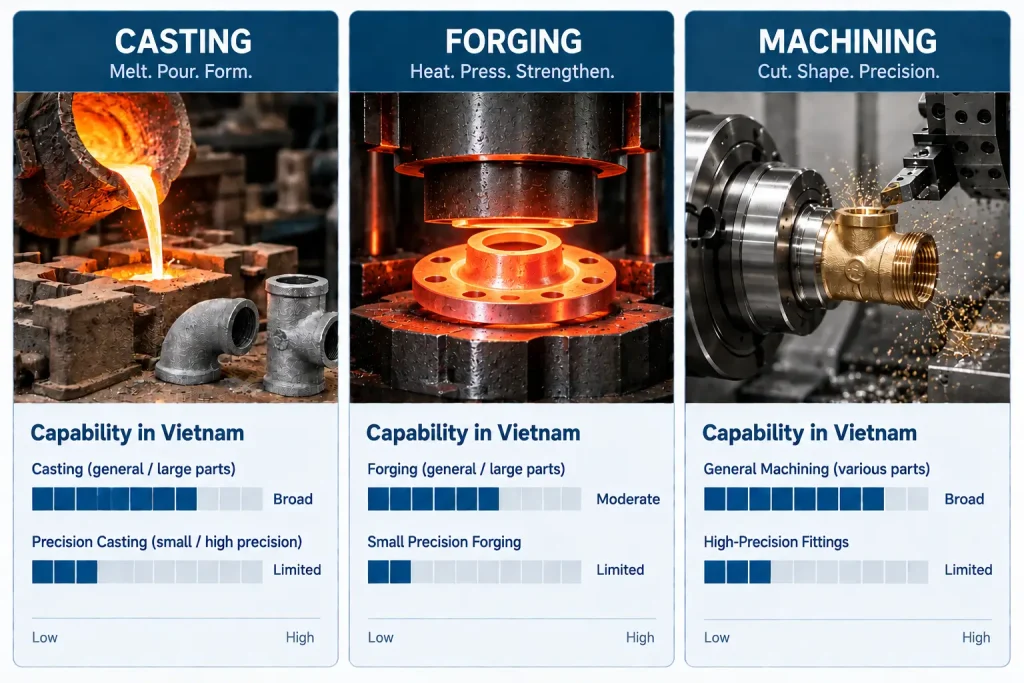
1. Casting
Vietnam has dozens of casting suppliers.
However, most casting factories focus on larger components or products that do not require very high dimensional accuracy.
This creates a limitation for small and precision fittings.
Small fittings often require:
- Better mold control
- More stable metal composition
- Better dimensional control
- Cleaner surfaces
- More precise machining
- Consistent thread quality
Therefore, the number of Vietnamese suppliers suitable for small precision casting fittings is much smaller than the total number of casting factories.
For buyers, this is an important sourcing point.
A factory that can cast large industrial parts may not be the right supplier for small precision fittings.
2. Hot Forging
Hot forging is another important production method.
Forging can provide strong mechanical properties and is often suitable for higher-quality fittings.
It is commonly considered for applications where strength and reliability are important.
However, Vietnam also has limitations in small and highly detailed forged fittings.
Some suppliers have strong experience with larger forged components. Smaller fittings may require more specialized tooling, equipment, and process control.
Therefore, supplier selection becomes critical when the project requires high-end forged fittings.
3. CNC Machining from Bar Stock
CNC machining is one of Vietnam’s stronger manufacturing capabilities.
There are many CNC machining suppliers across Vietnam. However, most of them do not focus only on pipe fittings.
Instead, they produce many different types of machined parts for industries such as:
- Automotive
- Industrial equipment
- Electronics
- Furniture hardware
- Construction
- Automation
- Consumer products
As a result, finding a supplier that specializes in high-precision pipe fittings can still be difficult.
The challenge becomes greater when the fittings require tight tolerances, precise threads, complex internal geometry, or pressure performance.
For more information about Vietnam’s CNC manufacturing capabilities, see Vietnam Machined Parts sourcing resource.
From Casting or Forging to Finished Fittings
Casting or forging is often only one step in the manufacturing process.
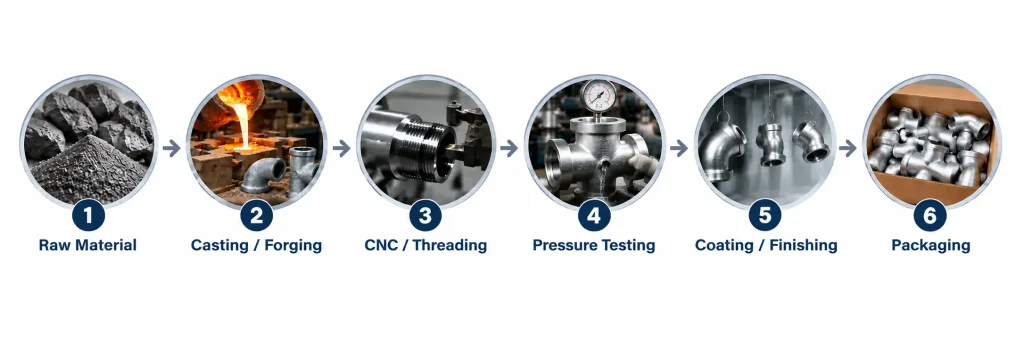
A typical production flow can include:
Raw Material → Casting / Forging → CNC Machining → Threading → Surface Finishing → Inspection → Packaging
For example, a forged fitting may still require CNC machining to achieve the final dimensions.
The supplier may also need to machine the internal and external threads.
After machining, the product may require surface treatment.
Finally, the supplier performs inspection and packaging before shipment.
This means buyers should evaluate the complete production chain instead of focusing only on the casting or forging process.
Machining and Threading
Thread quality is one of the most important factors for many pipe fittings.
Poor thread control can create:
- Leakage
- Difficult installation
- Poor connection strength
- Assembly problems
- Product rejection
Therefore, suppliers should have suitable CNC equipment, thread gauges, inspection tools, and process controls.
For high-volume projects, buyers should also review process consistency.
A supplier may produce a good sample but still struggle to maintain the same quality across thousands of pieces.
Testing and Inspection
Testing requirements depend on the fitting type and final application.
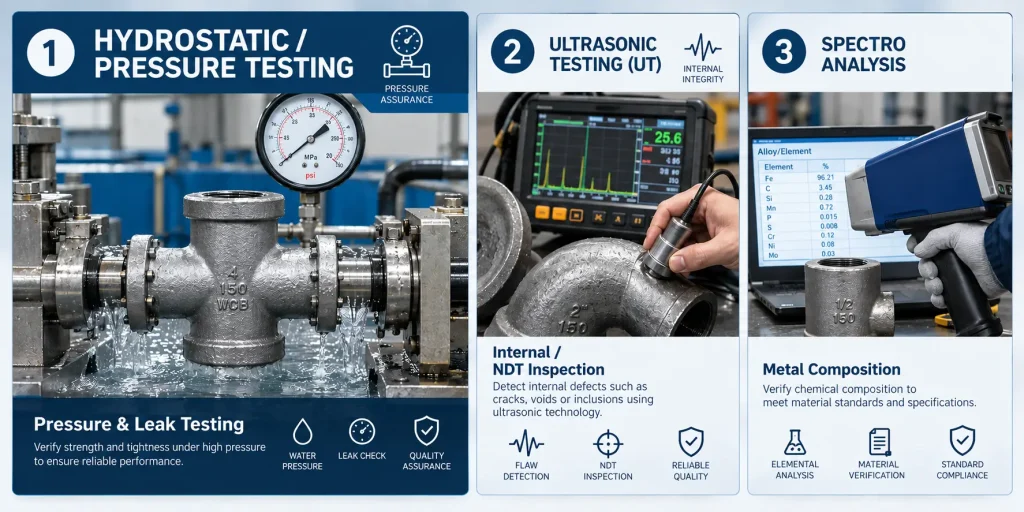
However, several testing methods are commonly considered for industrial fittings.
Hydrostatic Testing
Hydrostatic testing uses liquid pressure to check whether the fitting can withstand the required pressure.
It is particularly important for pressure-related applications.
Pressure and Leak Testing
Pressure testing can verify the performance of the finished fitting.
Leak testing can identify leakage from threads, joints, walls, or other critical areas.
These tests become especially important for plumbing, HVAC, industrial, and fluid-handling applications.
Ultrasonic Testing
Ultrasonic testing, or UT, can help identify internal defects in metal components.
It can be useful for certain forged or cast components where internal quality is important.
Spectro Analysis
Spectro analysis checks the chemical composition of the metal.
It can help verify whether the material matches the specified grade.
For buyers, this is particularly useful when the project requires specific steel, stainless steel, or other alloy grades.
Surface Finishing for Pipe Fittings
After casting, forging, or machining, fittings may require additional surface treatment.
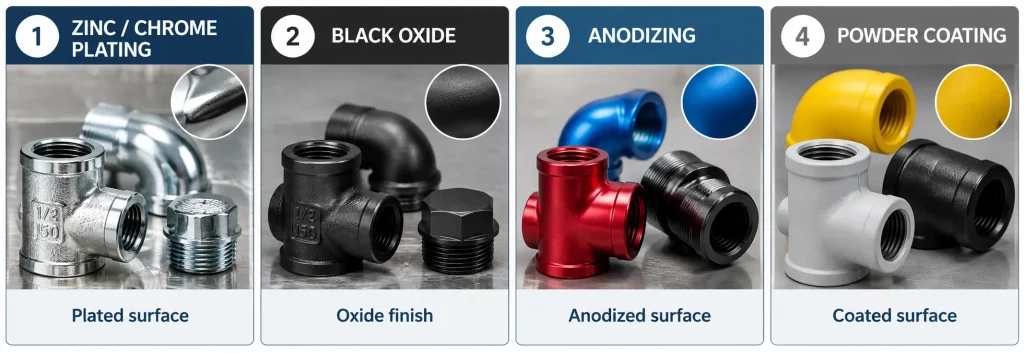
Common finishing methods include:
- Zinc plating
- Chrome plating
- Black oxide
- Powder coating
- Polishing
- Passivation for stainless steel
Anodizing is also common in Vietnam’s metal finishing industry. However, it is more suitable for aluminum and certain non-ferrous metals than for standard steel fittings.
The correct finish depends on the base material, application, corrosion requirements, appearance, and customer specification.
Standards for the North American Market
North American customers may require different standards depending on the fitting and its application.
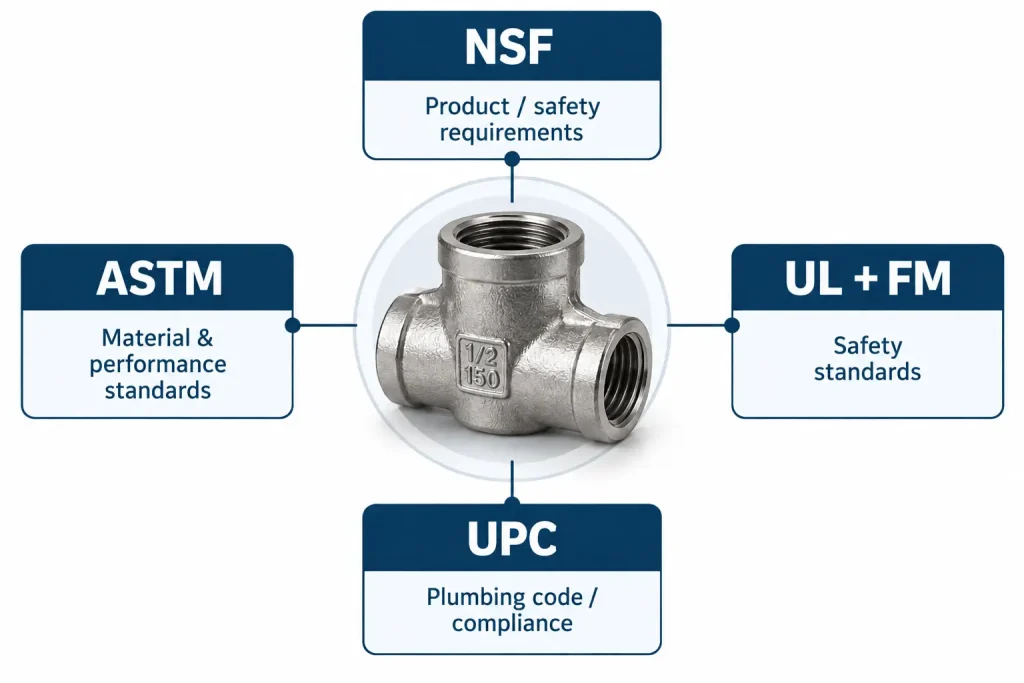
Common standards and certifications may include:
- ASTM
- NSF
- UL
- UPC
- ASME
- ANSI
However, not every fitting needs every standard.
The correct requirement depends on the product, material, application, pressure rating, and market.
Therefore, buyers should define the required standard before supplier selection.
This can prevent a common sourcing problem: finding a factory that can manufacture the product but cannot support the required certification or testing.
Applications of Pipe Fittings
Vietnam Pipe Fittings can serve many industries.
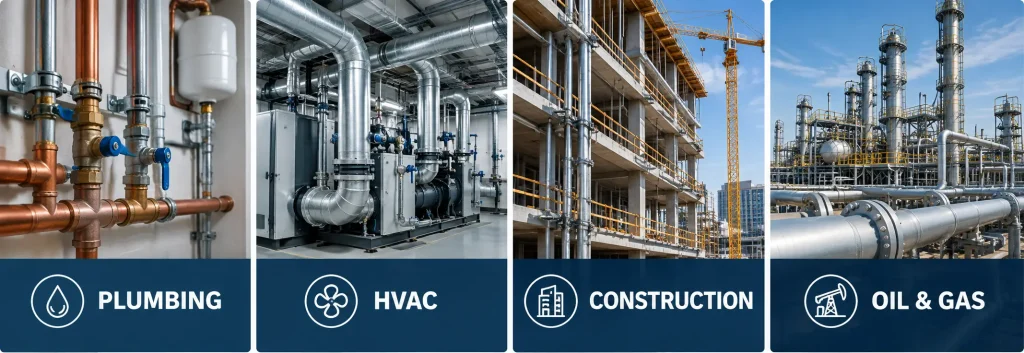
Common applications include:
- Oil and gas
- Construction
- Plumbing
- HVAC
- Water systems
- Industrial equipment
- Chemical processing
- Agriculture
- Infrastructure
However, the supplier requirements can vary greatly between industries.
For example, a basic construction fitting may have different requirements from a fitting used in a high-pressure industrial system.
Vietnam vs. China vs. India Pipe Fittings Manufacturers
Vietnam is not always the lowest-cost option.
Instead, its main value can come from supply chain diversification, competitive labor costs, and growing manufacturing capabilities.
Vietnam
Advantages:
- Competitive manufacturing cost
- Growing metalworking industry
- Strong CNC machining base
- Good option for China diversification
- Increasing experience with US customers
- Non-China manufacturing option
Challenges:
- Fewer specialized pipe fitting manufacturers
- Limited options for some small precision castings
- Limited options for certain small forged fittings
- Supplier quality can vary significantly
- Some factories lack direct export experience
China
Advantages:
- Very large fitting supplier base
- Strong casting and forging capabilities
- Strong tooling ecosystem
- Large-scale production
- Wide material and product selection
- Mature supply chain
Challenges:
- Higher geopolitical and tariff risks for US buyers
- China supply chain concentration
- Increasing pressure to diversify manufacturing
India
Advantages:
- Strong forging industry
- Large stainless steel and carbon steel manufacturing base
- Many experienced fitting exporters
- Strong capabilities for industrial fittings
- Good option for some high-volume products
Challenges:
- Supplier quality varies
- Lead times can vary
- Some projects still require extensive supplier qualification
- Logistics can be less convenient depending on the US destination
Overall, Vietnam can be a strong alternative when the buyer wants to reduce dependence on China.
However, buyers should qualify the factory based on the exact fitting, process, material, and required standards.
The Transshipping and Origin Issue
Another important topic is the supply chain structure.
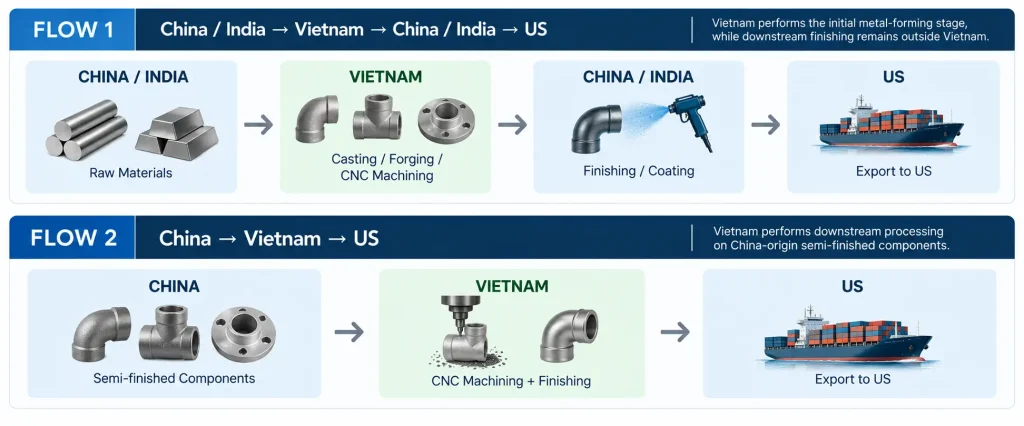
Some trading companies may source unfinished components from Vietnam, China, or India. They may then perform additional processing in another country.
For example, a company may source rough castings or forgings from Vietnam and perform machining or finishing elsewhere.
Another model works in the opposite direction. A company may source rough-formed parts from China and perform CNC machining, coating, or finishing in Vietnam.
These structures require careful review.
Importantly, the country of origin is not automatically determined by the final finishing step.
Customs authorities can consider the actual manufacturing process and whether the processing creates a substantial transformation.
Therefore, companies should not assume that adding CNC machining or coating in Vietnam automatically creates Vietnam origin.
US importers should maintain clear production records and review the applicable rules with qualified customs professionals.
This is especially important when the sourcing strategy is designed to address China-related tariffs or origin requirements.
Non-China Material Sourcing
For some US buyers, moving production to Vietnam is not enough.
They may also want to reduce dependence on Chinese raw materials.
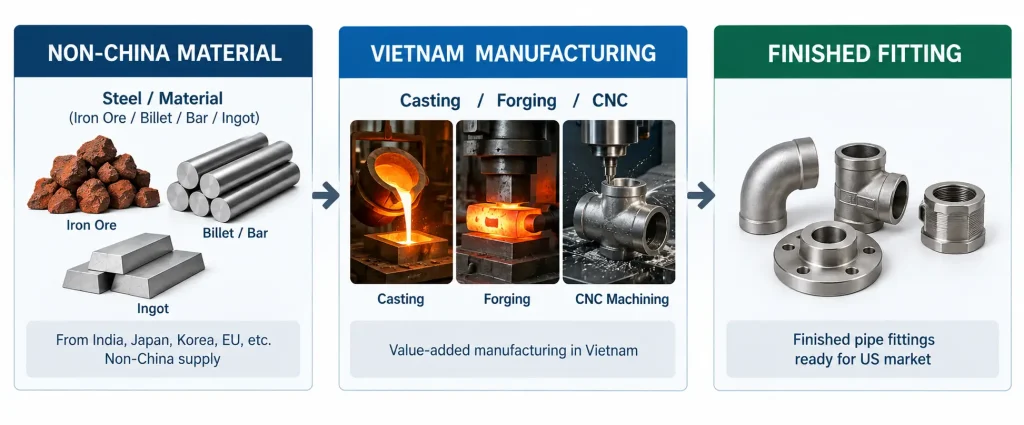
For example, a buyer may request:
Vietnam manufacturing + non-China steel
This can create a more diversified supply chain.
The supplier may need to source steel or other metal materials from countries outside China.
However, this requirement can increase cost and lead time.
Therefore, buyers should define the material origin requirement at the beginning of the project.
They should also request supporting documents when material origin is commercially or legally important.
What Makes Vietnam Pipe Fittings Difficult to Source?
The main challenge is not the availability of metal manufacturers.
Vietnam has many companies that can cast, forge, machine, and finish metal parts.
The challenge is finding the right combination of capabilities.
A qualified fitting supplier may need to provide:
- Suitable raw material
- Casting or forging capability
- CNC machining
- Accurate threading
- Surface finishing
- Pressure testing
- Material verification
- Dimensional inspection
- Export experience
- Required certifications
This combination is much harder to find than a factory that can simply manufacture a metal part.
How to Qualify a Vietnam Pipe Fittings Supplier
Before placing an order, buyers should check several areas.
Manufacturing Capability
Ask whether the supplier produces fittings in-house.
Also check which processes are outsourced.
Material Control
Confirm the material grade and source.
For critical applications, request material test reports and chemical composition records.
Production Process
Understand the complete process:
Casting / Forging → Machining → Threading → Finishing → Inspection → Packaging
This helps identify potential quality risks.
Testing Capability
Confirm whether the supplier can perform the required pressure, leak, ultrasonic, or material tests.
Quality System
Review the supplier’s inspection process.
For larger programs, buyers should consider pre-production, during-production, and final inspection.
Export Experience
A supplier with strong manufacturing skills may still have limited experience with US customers.
Export documentation, packaging, labeling, testing, and compliance can create additional risks.
Vietnam Pipe Fittings: The Sourcing Outlook
Vietnam has a growing metal manufacturing ecosystem.
The country has many casting, forging, machining, and finishing suppliers. However, the market is still fragmented.
The biggest opportunity is not simply finding a low-cost metal factory.
Instead, it is finding suppliers that can combine manufacturing capability with stable quality, testing, documentation, and export support.
For standard fittings, Vietnam can offer competitive sourcing options.
For high-precision or high-pressure fittings, supplier qualification becomes much more important.
Therefore, buyers should evaluate the entire supply chain rather than comparing unit prices alone.
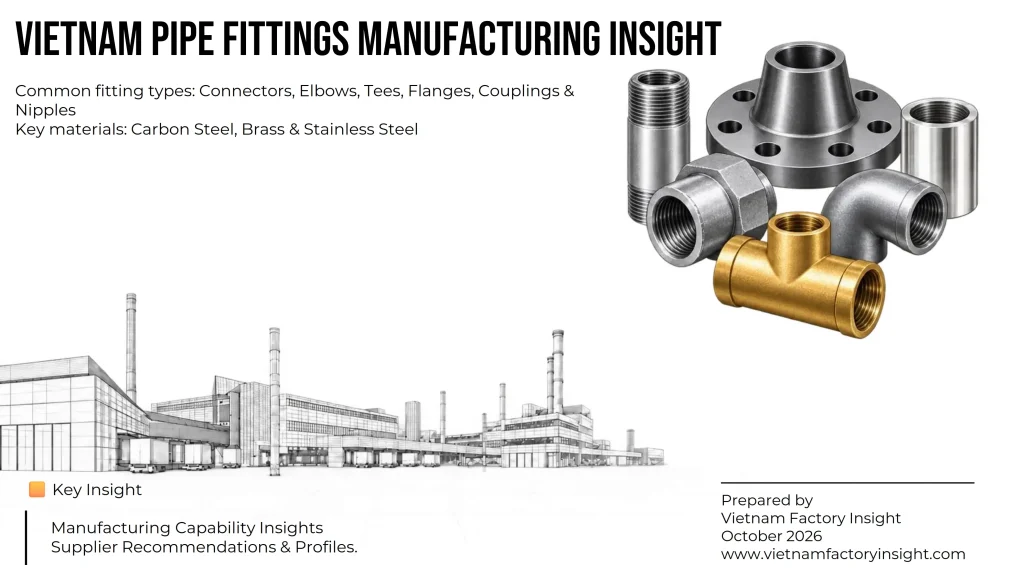
Sample Report: Vietnam Pipe Fittings Manufacturing Insight
Conclusion
Vietnam Pipe Fittings manufacturing offers a promising alternative for companies looking to diversify their supply chain outside China.
Vietnam has strong capabilities in CNC machining, casting, forging, and metal finishing. However, specialized suppliers for small, high-precision fittings are still more limited.
For this reason, successful sourcing requires a detailed supplier qualification process.
Buyers should review material, manufacturing process, machining capability, threading, testing, finishing, certification, and country-of-origin requirements.
With the right supplier, Vietnam can become a reliable part of a broader China-plus-one sourcing strategy for pipe fittings and other industrial metal components.
We will share more here