Introduction
Vietnam has built strong capabilities in ceramic and porcelain manufacturing. As a result, the country is becoming an interesting sourcing option for bathroom products.
However, not every plumbing product has the same level of local supply. Vietnam has clear strengths in ceramic products. At the same time, some non-ceramic components still depend on suppliers from other countries.
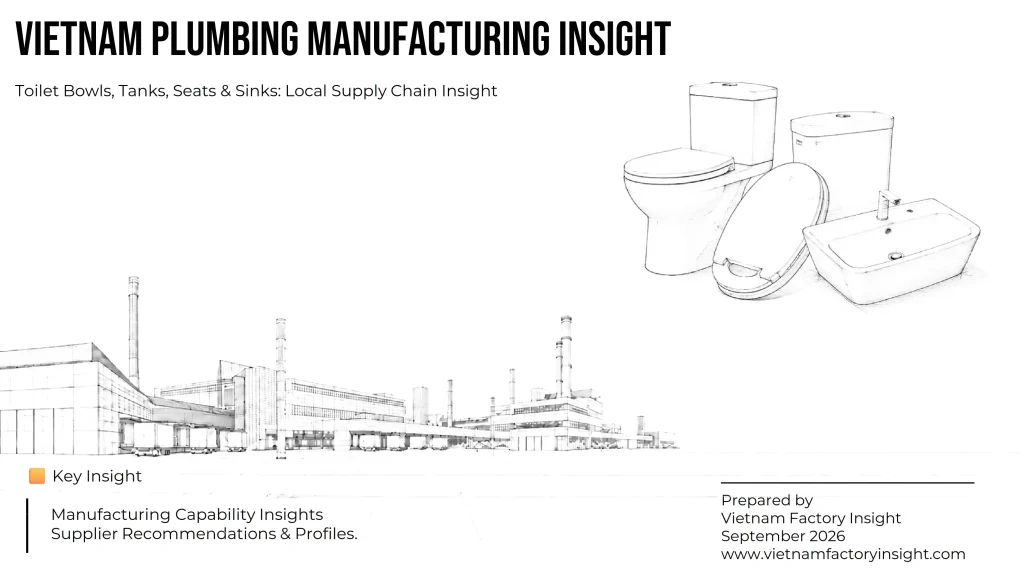
This Vietnam plumbing manufacturing insight reviews four key products: toilet bowls, toilet tanks, toilet seats, and bathroom sinks. It also looks at the current supply chain and identifies the most practical sourcing opportunities.
The assessment is based on manufacturing capability, product complexity, and supply chain readiness.
Vietnam Plumbing Manufacturing: Current Position
Vietnam has established ceramic and porcelain production capabilities. In addition, local manufacturers already serve export markets.
However, ceramic production does not always mean a factory can make a complete plumbing system.
A complete toilet product may require:
- Product engineering
- Specialized tooling
- Ceramic forming
- Component integration
- Functional testing
- Hardware and mechanism integration
- Reliable supporting suppliers
Therefore, buyers should look beyond basic ceramic production when evaluating a supplier.
The main issue is not simply whether Vietnam can form ceramic parts. Instead, the key issue is whether the local supply chain can support the complete product.
This difference becomes clear when comparing toilet bowls, toilet tanks, toilet seats, and bathroom sinks.
Toilet Bowl and Tank Manufacturing in Vietnam
Vietnam has strong ceramic manufacturing capabilities. However, toilet bowls and tanks are still largely sourced from China, according to the report.
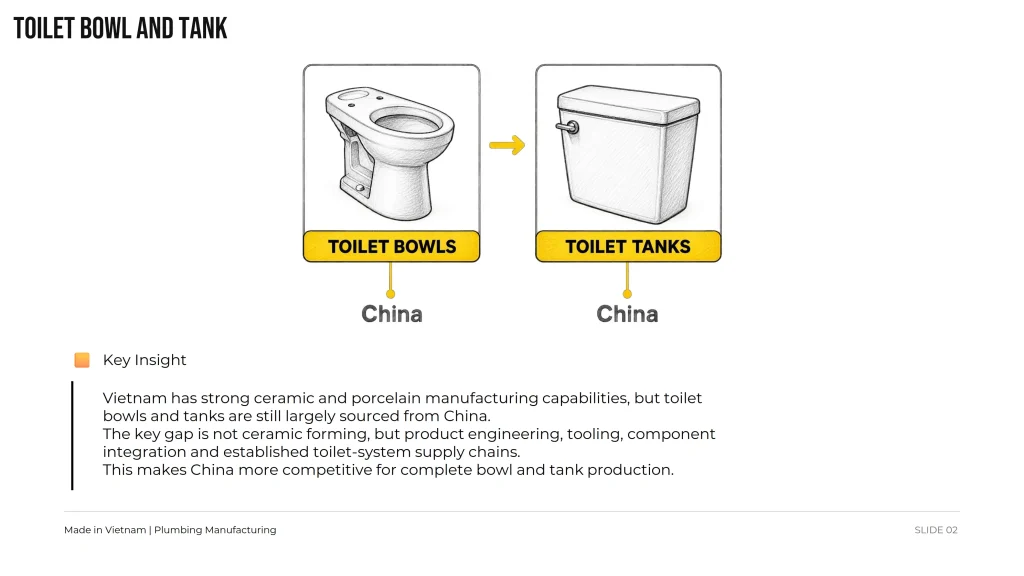
The main gap is not ceramic forming. Instead, the challenge comes from product engineering, tooling, component integration, and complete toilet-system supply chains.
Therefore, China remains more competitive for complete bowl and tank production.
For buyers, this means Vietnam may have the basic manufacturing capability. However, the full supply chain may not yet match China’s level of integration.
Key considerations for toilet bowls and tanks
When sourcing these products, buyers should review:
- Ceramic forming capability
- Mold and tooling capability
- Product engineering support
- Component sourcing
- Assembly requirements
- Functional testing
- Production scale
- Export experience
As a result, buyers should not select a supplier based only on its ceramic factory or product catalog.
A factory may have suitable ceramic equipment but still lack the supporting supply chain for a complete toilet system.
Toilet Seat Manufacturing in Vietnam
Toilet seats show a different supply chain challenge.
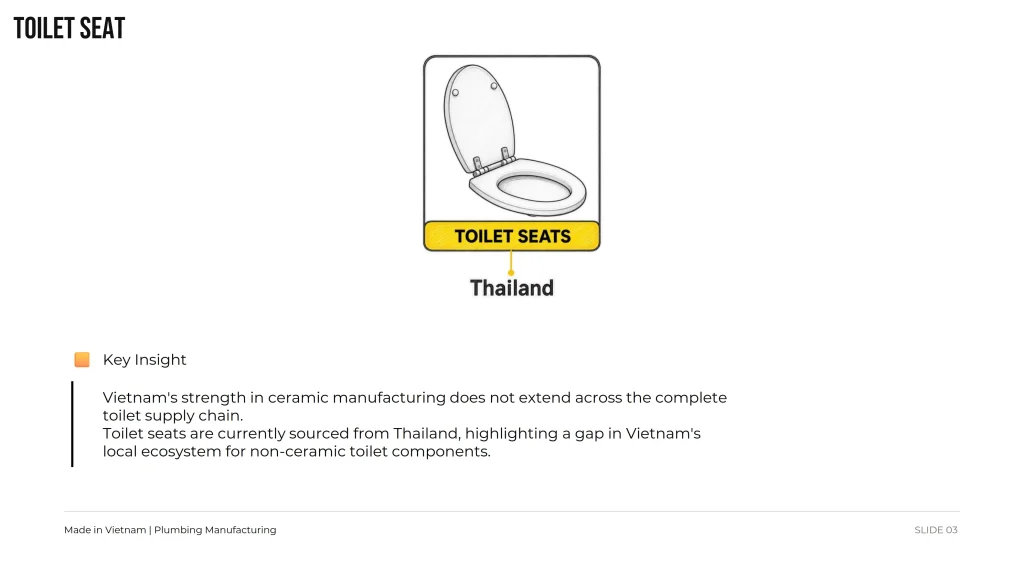
Vietnam has strong ceramic manufacturing capabilities. However, these capabilities do not cover the complete toilet supply chain.
According to the report, toilet seats are currently sourced from Thailand. This highlights a gap in Vietnam’s local supply of non-ceramic toilet components.
Toilet seats require different production processes, including:
- Injection molding
- Compression molding
- Hinge assembly
- Plastic component production
- Hardware integration
Therefore, ceramic strength alone does not create a complete toilet supply chain.
For buyers, Thailand can play an important role in a wider Southeast Asian sourcing strategy. Instead of requiring every component to come from Vietnam, companies can combine suppliers based on their strongest capabilities.
This approach may create a more practical regional supply chain.
Bathroom Sink Manufacturing in Vietnam
Bathroom sinks represent one of Vietnam’s strongest positions in the ceramic plumbing supply chain.
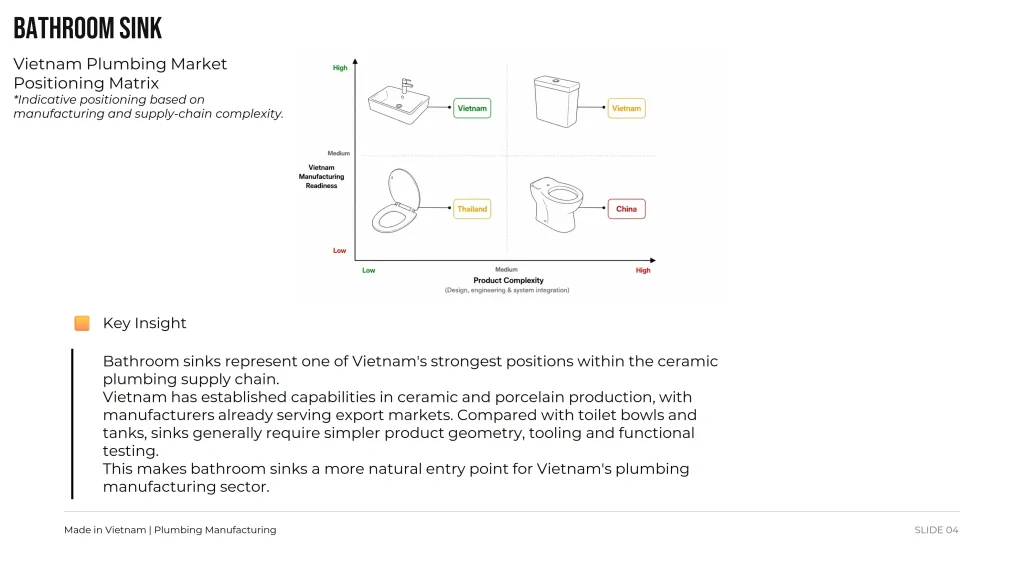
Vietnam already has ceramic and porcelain manufacturers serving export markets. Moreover, bathroom sinks generally have simpler product requirements than complete toilet systems.
They usually require:
- Simpler product geometry
- Less complex tooling
- Fewer integrated components
- More straightforward functional testing
Therefore, bathroom sinks can be a natural starting point for buyers exploring Vietnam plumbing manufacturing.
This does not mean every bathroom sink project will be suitable. Buyers should still check factory capacity, quality, tooling, packaging, and export experience.
However, the existing manufacturing base makes bathroom sinks a particularly relevant category for Vietnam sourcing.
Vietnam Plumbing Manufacturing Positioning
The report includes a positioning matrix that compares product complexity with Vietnam’s manufacturing readiness.
The matrix shows a clear difference between the four product categories.
Bathroom sinks have a strong position because Vietnam already has suitable ceramic capabilities. Toilet bowls have higher complexity and require stronger engineering and system integration.
Meanwhile, toilet seats have lower product complexity but weaker local manufacturing readiness.
Toilet tanks sit between these categories.
Therefore, product complexity alone does not determine sourcing feasibility. Supply chain readiness also plays an important role.
The matrix is an indicative view based on manufacturing and supply-chain complexity. It does not represent market size or sales potential.
Vietnam vs. Southeast Asia Plumbing Suppliers
Vietnam does not need to manufacture every plumbing component locally to become a useful sourcing base.
Instead, buyers can build a regional supply chain.
For example:
| Product | Current Supply Base | Main Consideration |
|---|---|---|
| Toilet Bowl | China | Higher product and system complexity |
| Toilet Tank | China / Vietnam potential | Ceramic capability and supply chain |
| Toilet Seat | Thailand | Molding and hinge assembly |
| Bathroom Sink | Vietnam | Strong ceramic manufacturing base |
This model creates a different way to approach Southeast Asian sourcing.
Rather than replacing China with one country, buyers can distribute production across several countries.
For example, Vietnam can support ceramic bathroom sinks. Thailand can support toilet seats. More complex toilet systems can remain with suppliers that have stronger engineering and integration capabilities.
As a result, companies can build a more flexible supply chain without forcing every product into the same manufacturing location.
Vietnam Plumbing Supplier Landscape
The report identifies recommended supplier profiles for the main product categories.
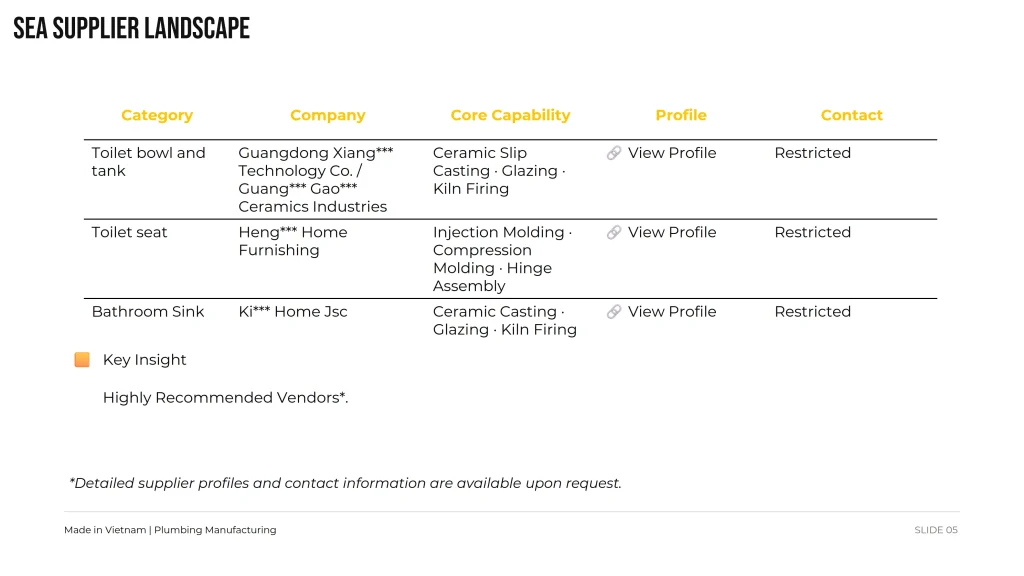
For toilet bowls and tanks, the listed supplier capabilities include:
- Ceramic slip casting
- Glazing
- Kiln firing
These processes support ceramic sanitaryware production.
For toilet seats, the supplier profile includes:
- Injection molding
- Compression molding
- Hinge assembly
Meanwhile, the bathroom sink supplier profile includes:
- Ceramic casting
- Glazing
- Kiln firing
This supplier mix reflects the different production needs of each category.
The report also notes that detailed supplier profiles and contact information are available upon request.
Key Challenges in Vietnam Plumbing Manufacturing
Vietnam offers good opportunities, but buyers should understand the current limitations.
1. The local supply chain is not complete
Vietnam has strong ceramic production. However, some supporting components still come from other countries.
Toilet seats are one clear example, with Thailand currently serving as the source identified in the report.
2. Product engineering can be a gap
Complete toilet systems require more than ceramic forming.
They also require product development, tooling, component integration, and system-level support.
Therefore, buyers should evaluate engineering capability as well as factory production.
3. Tooling can affect project feasibility
Tooling requirements can increase project complexity.
For this reason, buyers should review tooling capability early in the sourcing process.
4. One factory may not cover the full product
A ceramic factory may not produce plastic seats, hinges, or other components.
Instead, buyers may need several suppliers to complete the product.
This is why supply chain mapping is important before production starts.
How to Evaluate Vietnam Plumbing Manufacturers
A structured supplier review can reduce sourcing risk.
Step 1: Define the product
First, separate the project into specific categories:
- Toilet bowl
- Toilet tank
- Toilet seat
- Bathroom sink
Do not assume that one factory can produce all four competitively.
Step 2: Review the production process
Next, understand how the factory makes the product.
For ceramic products, the process may include:
Ceramic Casting → Glazing → Kiln Firing → Inspection → Packaging
For toilet seats, the process may include:
Injection or Compression Molding → Hardware Integration → Hinge Assembly → Inspection → Packaging
This process review helps buyers understand the real factory capability.
Step 3: Map supporting suppliers
Then, identify which components come from local suppliers.
Also check which components require imports from Thailand, China, or other markets.
This step is especially important for products with plastic and metal components.
Step 4: Check export capability
Manufacturing capability is only one part of supplier qualification.
Buyers should also review:
- Export experience
- Production capacity
- Quality control
- Packaging capability
- Communication
- Project management
- Product consistency
Step 5: Compare the regional supply chain
Finally, compare Vietnam with other Southeast Asian suppliers.
The best option may not always have the lowest factory price.
Instead, buyers should compare the complete supply chain, including production, components, quality, logistics, and supplier coordination.
Is Vietnam a Good Plumbing Manufacturing Alternative?
Vietnam can be a strong option for selected plumbing products.
Bathroom sinks currently show the clearest opportunity. Vietnam already has suitable ceramic and porcelain capabilities. In addition, the product has lower system complexity than a complete toilet.
Toilet bowls and tanks present a more mixed picture. Vietnam has the ceramic foundation, but engineering, tooling, component integration, and system supply chains remain important challenges.
Toilet seats show another limitation. Thailand currently supplies this category in the report’s assessment.
Therefore, the best strategy may not be a simple move from China to Vietnam.
Instead, companies can use Vietnam as the center of a broader Southeast Asian supply chain.
This approach allows buyers to use each country for the products it can support best.
Sample Report: Vietnam Plumbing Manufacturing Insight
Conclusion
Vietnam has a strong foundation for ceramic and porcelain manufacturing. However, the country’s plumbing supply chain is still developing across different product categories.
Bathroom sinks currently offer one of the clearest sourcing opportunities. They fit well with Vietnam’s existing ceramic manufacturing capabilities.
Toilet bowls and tanks are more challenging because complete systems require stronger engineering, tooling, and component integration.
Meanwhile, toilet seats show the value of regional sourcing. Thailand can support components that are not yet widely available in Vietnam.
Overall, successful sourcing requires more than finding a factory. Buyers need to understand the complete supply chain and identify where each country can add value.
For companies looking beyond China, Vietnam can therefore serve as an important part of a stronger Southeast Asian plumbing supply chain.
Vietnam Factory Insight describes its focus as providing manufacturing capability insights, supplier recommendations, and supply chain intelligence.